Customs Brokerage Fees in Australia: What’s Included
 Azmi El-Ali
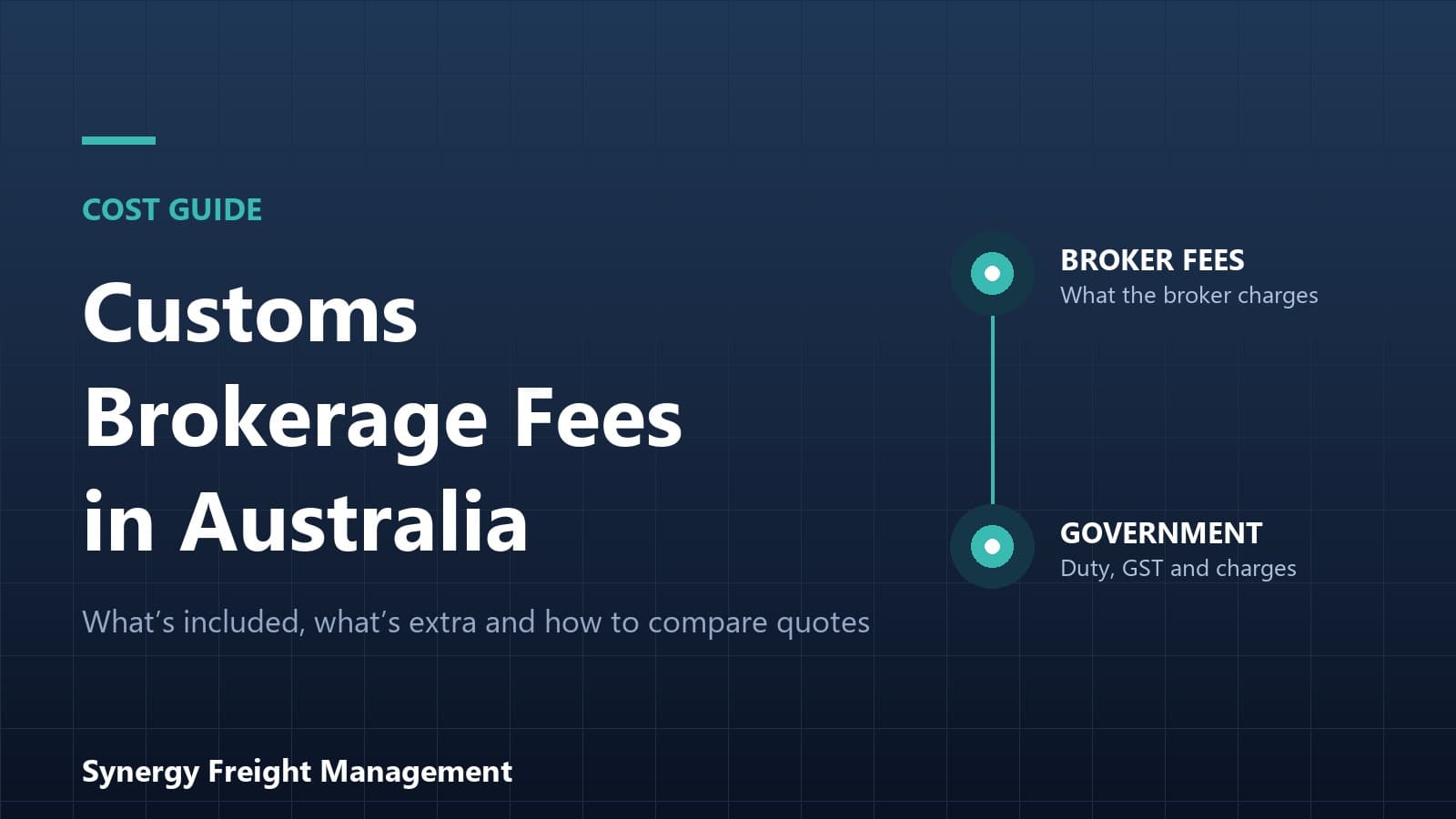
Most importers see customs costs as one lump. They are two different things: what the broker charges for handling your clearance, and what you pay the government because you imported goods. Mixing them up is why quotes look hard to compare.
The short answer
Customs brokerage is what a licensed customs broker charges to lodge your import declaration and manage your goods through clearance. It is separate from customs duty, GST and government charges, which are collected on your imports whichever broker you use.
Two buckets of customs brokerage cost
| What the broker charges | What goes to the government |
|---|---|
| Brokerage: classifying the goods, preparing and lodging the declaration, working out duty and GST, liaising with authorities, coordinating release | Customs duty (a rate set by tariff classification and origin) |
| Any extras you agree to (see below) | GST, 10% of the Value of Taxable Importation |
| Import Processing Charge on the declaration | |
| Biosecurity charges where applicable |
The government amounts are set by law and indexed, so a broker can’t discount them. For how duty and GST are calculated, read our guide to import duties in Australia.
What customs brokerage typically covers
At Synergy Freight Management, brokerage covers the work of getting a declaration right and cleared:
- Classification of your goods under the tariff, which decides the duty rate and whether permits are needed
- Lodging the declaration with the Australian Border Force (ABF), before your goods arrive
- Calculating duty and GST so there are no surprises on arrival
- Assessing Free Trade Agreement preference on every shipment, so you pay the lowest rate your goods qualify for
- Liaising with the Department of Agriculture, Fisheries and Forestry (DAFF) where biosecurity applies
- Coordinating release so goods can move on
Other brokers bundle customs brokerage differently, so use this list as a checklist when you compare quotes.
What is commonly charged on top
Ask about these before you accept a quote. None applies to every shipment:
- Disbursements, meaning third-party costs a broker pays on your behalf, and whether they are passed on at cost or with a markup
- Inspection or treatment attendance, if DAFF or the ABF refers your goods (see what to know about DAFF biosecurity)
- Storage and demurrage, if goods sit at the wharf or a container is held past free time (see demurrage and detention fees and wharf storage)
- Document corrections or amendments after lodgement
- After-hours or urgent lodgement
A low headline fee with several of these added later can cost more than a higher fee that includes them.
How brokers structure their fees
There is no standard model for customs brokerage pricing. Common approaches are a flat fee per declaration, a fee that rises with the number of tariff lines, or a minimum charge with extras billed separately. Each suits a different importer: a single-product container is cheap under per-declaration pricing, while a mixed shipment of many products usually costs more under per-line pricing.
When you ask for a quote, ask which model applies to your shipment, not an average one.
How to compare quotes like for like
Put each quote against the same questions:
- Does the fee include FTA preference assessment, or is that extra?
- Is there a minimum charge, and what does it cover?
- Are disbursements passed on at cost or marked up?
- What happens if the goods are referred for examination?
- Is the fee per declaration, per line or per shipment?
- Will you get a landed-cost breakdown before the goods arrive?
For more to ask a provider, see questions to ask your freight forwarder.
Where good customs brokerage saves you money
Customs brokerage is a cost, but the right broker often pays for themselves:
- Correct FTA preference. If your goods qualify under an agreement such as ChAFTA, claiming it can reduce or remove duty. It has to be claimed correctly, with the right origin documents.
- Avoiding delay costs. Declarations lodged before arrival and checked for errors reduce the chance of storage and demurrage charges accruing while goods are held.
- Correct classification. A wrong tariff code can mean overpaid duty or a later correction.
See the benefits of using a customs broker for more.
Frequently asked questions
How much does a customs broker cost in Australia?
There is no single figure, because the fee depends on your shipment. The main drivers are how many different products (tariff lines) are on the declaration, how complex the goods are to classify, and whether the shipment is referred for examination. Ask for a customs brokerage quote based on your actual goods, and check what it includes. Duty, GST and government charges are separate.
What is the Import Processing Charge?
It is a government charge on import declarations, paid whichever broker you use. The amount depends on the value of the consignment and how the declaration is lodged. Your broker should show it separately from their own fee.
Do I pay the broker or the government for duty?
Duty and GST are owed to the government. At Synergy Freight Management, we pay any duty and GST to the government on your behalf and then re-invoice you, with our own fee as a separate line. Arrangements differ between brokers, so ask how and when it works with yours.
Are customs broker fees GST-inclusive?
We quote our broker fees excluding GST, and GST is added on the invoice. Other brokers may differ, so confirm on each quote whether the figure includes GST so you compare like for like.
Can I clear goods myself to avoid broker fees?
Importers can lodge their own declarations, but it requires tariff knowledge and the right access to Australian Border Force systems, and a classification or valuation error can cost more than the fee saved. A licensed broker is the usual route for that reason.
Get a customs brokerage quote that shows the full picture
If you want costs laid out clearly, get a quote and ask for a landed-cost breakdown. We’ll show brokerage, duty, GST and government charges separately, before your goods arrive. You can also read about our customs clearance service.
Share this article
Azmi El-Ali
Managing Director, Synergy Freight Management
Azmi El-Ali is a Licensed Australian Customs Broker under the Customs Act 1901 with 10+ years experience in international freight forwarding. As Managing Director of Synergy Freight Management, Azmi helps businesses import and export goods with confidence.
Connect on LinkedIn