Customs Clearance Timeline: What to Do and When
 Azmi El-Ali
Most customs problems are decided before the goods leave the supplier. By the time cargo is at the port, the paperwork either works or it doesn’t. This customs clearance timeline walks through an import in order, so you know what needs doing at each stage and who should be doing it.
For how long clearance itself usually takes, see the timing section of our customs clearance guide. This page is the action plan around it.
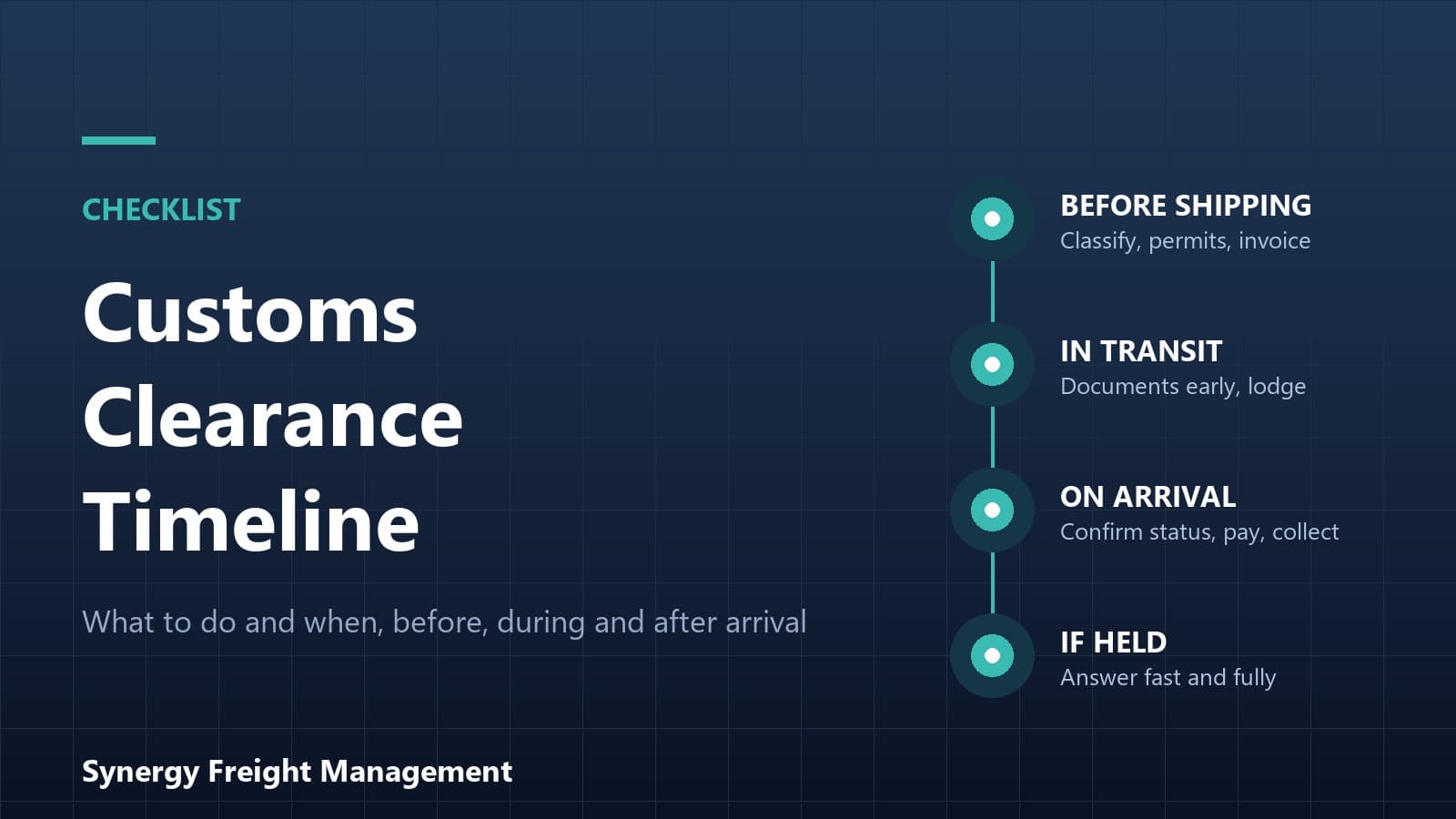
Before the goods ship
This first stage of the customs clearance timeline is the cheapest to get right and the most expensive to get wrong.
- Confirm the tariff classification. The tariff code decides the duty rate, whether a Free Trade Agreement preference applies and whether permits are needed. A wrong code means the wrong import requirements, wrong documents and a likely hold at the port. Check it with your broker before you place the order, not once the goods are on the water.
- Check for permits and restrictions. Some goods need a permit or approval before they can enter Australia. Finding out after the order is placed leaves you with stock you can’t release.
- Check biosecurity requirements. Timber packaging, plant material, food and used machinery can all attract Department of Agriculture, Fisheries and Forestry (DAFF) conditions. Read what to know about DAFF biosecurity before the supplier packs.
- Brief your supplier on the invoice. The commercial invoice should carry clear item descriptions, accurate values that match what you paid, the correct currency and the supplier’s details. “Parts” or “samples” is not a description. Agree the shipping terms (Incoterm) with the supplier too, so it is clear who pays for and arranges each leg.
- Decide on a Free Trade Agreement claim. If your goods qualify, get the certificate of origin from the supplier now. It is much harder to chase once the shipment has left.
While the cargo is in transit
The middle of the customs clearance timeline is working time, not waiting time.
- Get your broker the documents early. Send the commercial invoice, packing list and bill of lading as soon as you have them. Documents that arrive late are the usual reason a declaration is lodged late.
- Lodge the import declaration before arrival where you can. Pre-lodgement moves the checking forward, so an assessed declaration is waiting when the cargo lands. A declaration lodged after arrival starts its work at the wharf, where charges may already be accruing. For what those look like, see wharf storage, side loader and depot fees.
- Line up delivery. Book the transport provider before the cargo lands, and know whether it is a full container or a shared one.
- Keep an eye on the vessel. Delays to a vessel’s arrival change your plan. Allow for them, especially if the port is under pressure; see port congestion and what it costs you.
When the cargo arrives
Arrival is the point where the rest of your customs clearance timeline either runs smoothly or stalls.
- Check the declaration status with your broker. You want to hear that it is assessed, duty is paid and goods are cleared to release. If anything is outstanding, this is when you find out, not when the truck is waiting.
- Pay duty and GST promptly. Release depends on it.
- If the container is shared (LCL), expect a depot step. Your goods have to be unpacked before they can leave. See what deconsolidation involves.
- Confirm the pick-up booking. Terminal and transport slots are limited. A missed slot can cost a day or more even when customs has done nothing wrong.
If customs holds the shipment
A hold is not a failure. It means the Australian Border Force (ABF) or DAFF needs more information or wants to look at the goods. What you do next decides how long it lasts, and how far your customs clearance timeline slips.
- Find out what kind of hold it is. A request for documents, a valuation query, a biosecurity referral and a physical examination each need a different response. Ask your broker to tell you exactly which.
- Answer fast and completely. The shipment waits until the requested information is supplied. Incomplete answers start a second round.
- Make the documents agree. An invoice, payment record and packing list that contradict each other will prompt more questions.
- Plan for treatment if DAFF requires it. Fumigation or re-export decisions take extra time and cost money, so decide quickly.
- Tell your customer or site early. If the delay will affect a delivery date, say so before they ask.
Our guide to customs delays in Australia covers the causes of holds in more detail.
A one-page customs clearance checklist
| Stage | Do this | Who |
|---|---|---|
| Before shipping | Classify the goods, check permits and biosecurity rules, brief the supplier on the invoice, sort any FTA certificate | You and your broker |
| In transit | Send documents early, lodge before arrival, book delivery | Your broker and you |
| On arrival | Confirm clearance status, pay duty and GST, confirm pick-up | Your broker and you |
| If held | Identify the hold type, answer completely and fast, align the documents | Your broker, with your input |
If your cargo is time-critical and moving by air, see our guide to time-sensitive air freight.
Who should manage your customs clearance timeline
A licensed customs broker takes most of this off your plate: checking the classification, preparing and lodging the declaration, tracking it through the ABF system and chasing any query before it becomes a delay. Synergy Freight Management holds a corporate customs broker’s licence with accredited individual nominees, lodges declarations itself rather than through a third-party agent, and lodges before your cargo arrives where it can. Because we also handle the freight forwarding, there is one point of contact from supplier to delivery rather than a hand-off between companies. Learn more about our customs clearance service.
Frequently asked questions
What do I need to do before and after my goods arrive?
Before they ship: classify the goods, check permits and biosecurity rules, and brief your supplier on the invoice. While they are in transit: get the documents to your broker and lodge the declaration before arrival. On arrival: confirm the declaration is assessed, pay duty and GST, and book pick-up. A broker usually handles the declaration on your behalf.
When should I start preparing for customs clearance?
Your customs clearance timeline starts before you place the order. Classification, permits and biosecurity rules affect cost and feasibility, and the supplier can only fix an invoice or packaging problem before the goods ship.
How to speed up customs clearance
You can’t pay your way to the front of the queue, but you can remove the usual causes of delay: accurate invoices, correct classification, biosecurity-compliant packing and early lodgement. For typical timings, see our customs clearance guide.
What should I do if my shipment is held?
Find out what kind of hold it is, supply what is asked for completely and quickly, and make sure the invoice, payment record and packing list agree. Your broker should manage the exchange with the ABF or DAFF.
Do I need a customs broker to clear goods?
Many importers use a licensed broker because the declaration is technical and errors are costly. Some low-value or simple imports can be handled without one, but a broker is the safer route for commercial shipments.
Get your customs clearance timeline right from the start
Get a quote and tell us what you’re importing and from where. We’ll confirm what’s required before you ship and give you a full landed-cost breakdown before your goods arrive.
Share this article
Azmi El-Ali
Managing Director, Synergy Freight Management
Azmi El-Ali is a Licensed Australian Customs Broker under the Customs Act 1901 with 10+ years experience in international freight forwarding. As Managing Director of Synergy Freight Management, Azmi helps businesses import and export goods with confidence.
Connect on LinkedIn