Freight Forwarder vs Customs Broker vs Freight Broker: What’s the Difference?
 Azmi El-Ali
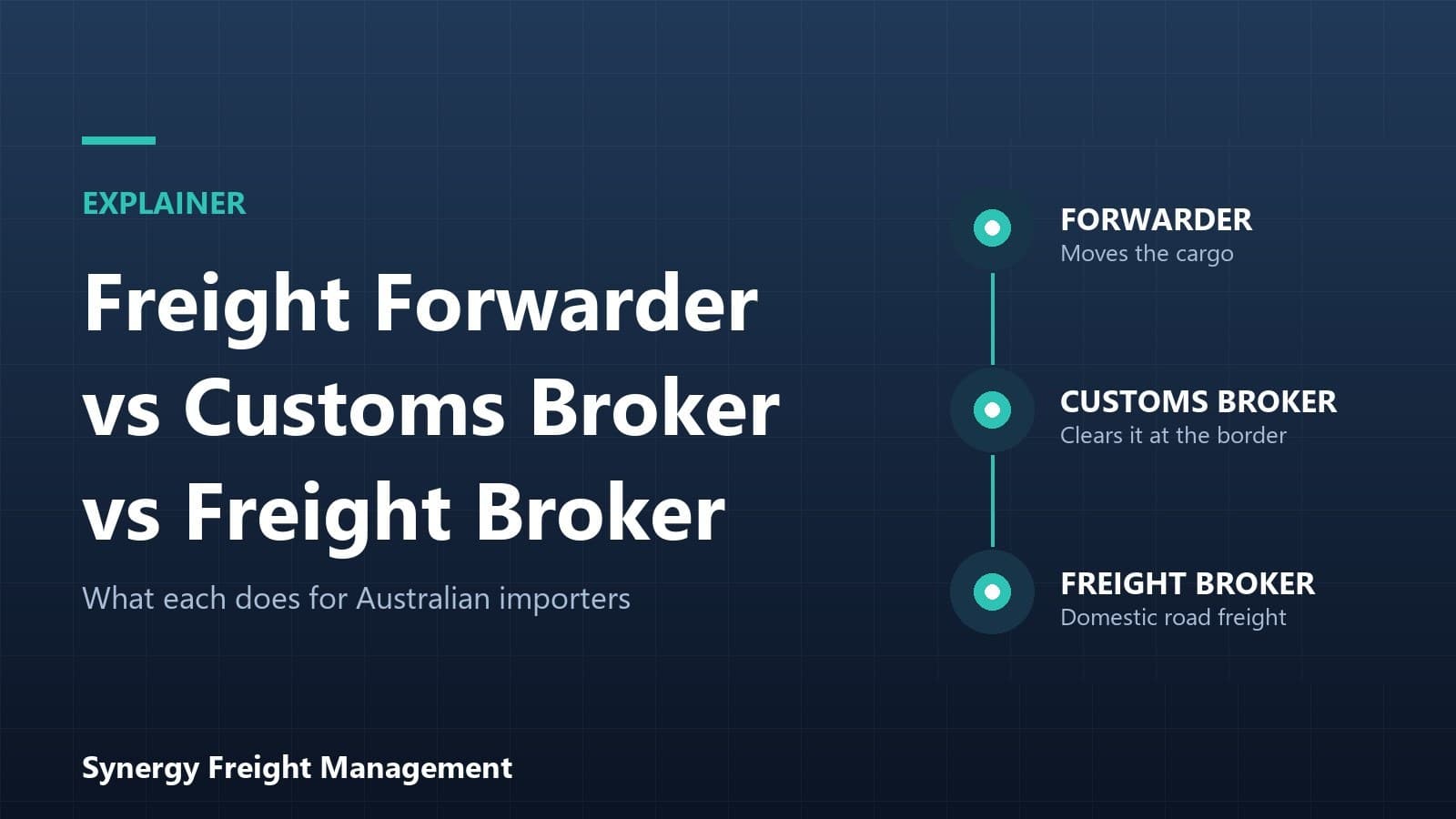
If you’re importing into Australia, you’ll hear three job titles used as though they mean the same thing: freight forwarder, customs broker and freight broker. They don’t. Each does a different job, carries different responsibilities, and only one of them is licensed to clear your goods through Australian customs.
Here’s what each one does, how they differ, and which ones you actually need.
The short answer
A freight forwarder arranges and manages the movement of your cargo from overseas to Australia. A customs broker is licensed to lodge your import declaration with Australian Border Force and clear your goods. A freight broker usually arranges road transport within Australia. Most importers need a forwarder and a customs broker, and some providers, including Synergy Freight Management, offer both.
Freight forwarder, customs broker and freight broker side by side
| Freight forwarder | Customs broker | Freight broker | |
|---|---|---|---|
| What they do | Plan and manage the movement of cargo: book space with shipping lines and airlines, consolidate cargo, coordinate each leg | Lodge your import declaration with Australian Border Force, classify your goods, assess duty and GST, handle biosecurity paperwork | Match your load with a transport provider, most often a trucking company, and negotiate on your behalf |
| Who they act for | You, the shipper | You, the importer | You, the shipper |
| Handles the physical freight? | Often arranges it or contracts for it | No, they handle the paperwork | No, the carrier does |
| Licensed? | Forwarding itself doesn’t need a customs broker’s licence | Yes, licensed under the Customs Act 1901 | No customs licence needed |
| Where they fit | International shipping: sea, air and road legs | The border: clearing goods into Australia | Mostly domestic road freight within Australia |
| Typically charges for | Freight services: origin, sea or air, and destination charges | Their fee for lodging and managing clearance, separate from duty and GST | A margin on the transport they arrange |
What a freight forwarder does
A freight forwarder is responsible for getting your goods from the supplier’s door to a destination you choose. In practice that means booking space with shipping lines or airlines, consolidating your cargo with other shipments where that lowers cost, and coordinating the legs of the journey across sea, air and road.
When you ask for a “door-to-door” quote, the forwarder is the party building it. They are the ones you talk to about transit options, cargo readiness and where your shipment is.
What a forwarder does not automatically do is clear your goods through customs. Forwarding itself doesn’t require a customs broker’s licence, so a forwarder that isn’t also a licensed customs broker has to pass the declaration to someone who is. That hand-off is where many delays and unclear responsibilities start.
Learn more: sea freight forwarding and air freight forwarding.
What a customs broker does
A customs broker deals with the border. Every commercial shipment that comes into Australia is declared to Australian Border Force, and goods must also meet biosecurity rules set by the Department of Agriculture, Fisheries and Forestry. A licensed customs broker handles that process for you.
Typically that includes:
- Classifying your goods so the right tariff and duty rate applies
- Lodging the import declaration with Australian Border Force
- Assessing duty and GST, and checking whether a Free Trade Agreement preference applies to your goods
- Handling biosecurity paperwork and working through any inspection or treatment requirements
- Coordinating release of your cargo once clearance is complete
Only two parties can lodge an import declaration: the owner of the goods, or a licensed customs broker. Most businesses use a broker because classification mistakes and missed Free Trade Agreement claims are easy to make and costly to fix.
Learn more: customs clearance services and our guide to customs clearance in Australia.
What a freight broker does (and doesn’t)
In Australia, “freight broker” most often refers to someone who matches a load with a carrier, usually a trucking company, and negotiates the rate. If you search for “freight broker”, many of the results are domestic road-freight businesses.
A freight broker doesn’t normally book your container, and they don’t clear your goods through customs. If you’re importing from overseas, a freight broker on its own won’t cover the international leg or the border.
The term is also used loosely. Some businesses describe both forwarding and customs services as “freight brokerage”. If a company calls itself a freight broker, ask whether it is a licensed customs broker and whether it manages international shipping, or only arranges transport within Australia. For a closer look at how the two terms overlap, see our guide to freight brokers and freight forwarders.
Do you need all three?
For international imports you need two functions covered: moving the goods, and clearing them. A freight broker is only relevant for the domestic leg, if at all. Here is how that plays out:
- First-time importer bringing in a container. You need freight forwarding and customs clearance. Using one provider for both means one contact from supplier to delivery, rather than a forwarder and a separate broker passing information between them.
- Regular container importer. The same two functions apply, and the value is in how well they work together. Declarations lodged before the vessel arrives help avoid port storage charges, which is easier when forwarding and clearance sit with the same team.
- Small air freight consignments. The functions are the same, but the shipment may move through an air freight forwarder who bundles clearance into the service. Low-value consignments can follow simpler rules; see our guide to low-value imports and GST.
- Moving goods around Australia after clearance. This is where a domestic freight broker or carrier comes in. If you want delivery arranged as part of the same shipment, ask your forwarder to coordinate it.
When one provider does forwarding and customs
Synergy Freight Management is a licensed customs broker and a freight forwarder. We hold a corporate customs broker’s licence and work with accredited individual nominees, lodge declarations ourselves rather than through a third-party agent, and lodge before your vessel arrives. Because we handle both sides, there’s no hand-off between a forwarder and a separate broker, and you have one point of contact from supplier to delivery.
If you’re comparing providers, our checklist of questions to ask your freight forwarder and our guide to choosing the right freight forwarder will help you compare like for like. If you’re weighing up whether a broker is worth it, read the benefits of using a customs broker.
Frequently asked questions
Is a freight forwarder the same as a customs broker?
No. A freight forwarder arranges and manages the transport of your cargo. A customs broker is licensed to lodge your import declaration and clear goods through Australian Border Force. Some companies do both, but they are separate roles, and only the customs broker role requires a customs licence.
Can a freight forwarder clear my goods through customs?
Only if the forwarder is also a licensed customs broker, or passes the declaration to one. Under the Customs Act 1901 only the owner of the goods or a licensed customs broker can lodge an import declaration, so a forwarder without a licence can’t lodge it themselves.
Do I need a customs broker if I use a freight forwarder?
You need someone licensed to lodge your declaration. If your forwarder is also a licensed customs broker, you don’t need a second company. If it isn’t, it will work with a broker on your behalf, or you can appoint one directly.
What does a freight broker do in Australia?
A freight broker connects a shipper with a carrier, most often a trucking company, and negotiates the rate. It is mainly a domestic service. A freight broker doesn’t normally book international sea or air freight, and doesn’t clear imports through customs.
Which is cheaper: a freight forwarder, a customs broker or a freight broker?
They charge for different things, so they aren’t directly comparable. A forwarder charges for freight services, a customs broker charges a fee for clearance separate from duty and GST, and a freight broker earns a margin on transport. Ask each for a quote that shows exactly what’s included.
Get one team for forwarding and customs
If you’re planning an import and aren’t sure which roles you need, get a quote and tell us what you’re shipping. We’ll confirm what’s required and give you a full landed-cost breakdown before your goods arrive.
Share this article
Azmi El-Ali
Managing Director, Synergy Freight Management
Azmi El-Ali is a Licensed Australian Customs Broker under the Customs Act 1901 with 10+ years experience in international freight forwarding. As Managing Director of Synergy Freight Management, Azmi helps businesses import and export goods with confidence.
Connect on LinkedIn